
Answer by Suzanne L. Marchand
This is an excellent question, but as a full answer would take us across many fields of knowledge, national contexts, and time periods, I will try here simply to sketch the early modern story (c. 1474 to 1789) in broad strokes.
Herodotus’ full text was unknown in western Europe until the fifteenth century, though some stories, carried in Latin or Christian authors, or in images, endured. Rebirth began with the circulation of partial translations in fifteenth-century Italy, culminating in Lorenzo Valla’s Latin translation, published in 1474. If readers were mostly Italians before 1500, after that time, German, French, and Dutch humanists joined in, among the most prominent Philip Melanchthon and Michel de Montaigne.
In general, Herodotus’ reputation for truthfulness, gleaned from his ancient critics, was dismal. In the age of historia magistra vitae—in which history was put in the service of teaching princes wise statecraft by example—however, his stories about despotic kings were highly useful negative examples. Most readers seem hardly to have read past books 1 or 2, though this makes sense when we recall that while the history of the ancient Near East was familiar from the Hebrew Bible, almost no one paid much attention to ‘pagan’ Greek history before Alexander, except to note that the fall of Athens during the Peloponnesian War was proof that democracies were unstable, corrupt, and destined to fail.
In the sixteenth and seventeenth centuries, there were important uses of Herodotus’ stories about Tomyris, Cambyses’ judgement of Sisamnes, and Solon and Croesus, which we can see clearly in the pictorial record. The first story, illustrated here by one of the two versions made by J. P. Rubens (Fig. 1), seems to have appealed both to female and male rulers, who wished, perhaps, to identify themselves with stoic fortitude and just war. This particular painting hung in Louis XIV’s throne room in Versailles from 1682 and seems not to have been removed until the French Revolution. The second parable was widely deployed as a subject for frescoes displayed in municipal townhalls, here in Bruges (Fig. 2), to demonstrate the imperative necessity of impartial justice. The Solon and Croesus story was beloved by Dutch painters warning of the evils of fetishizing worldly treasures. But generally, Herodotus before about 1700 was relatively little read and cited, and when his stories are invoked, it is often clear that readers know the tales through excerpts or second-hand readings.
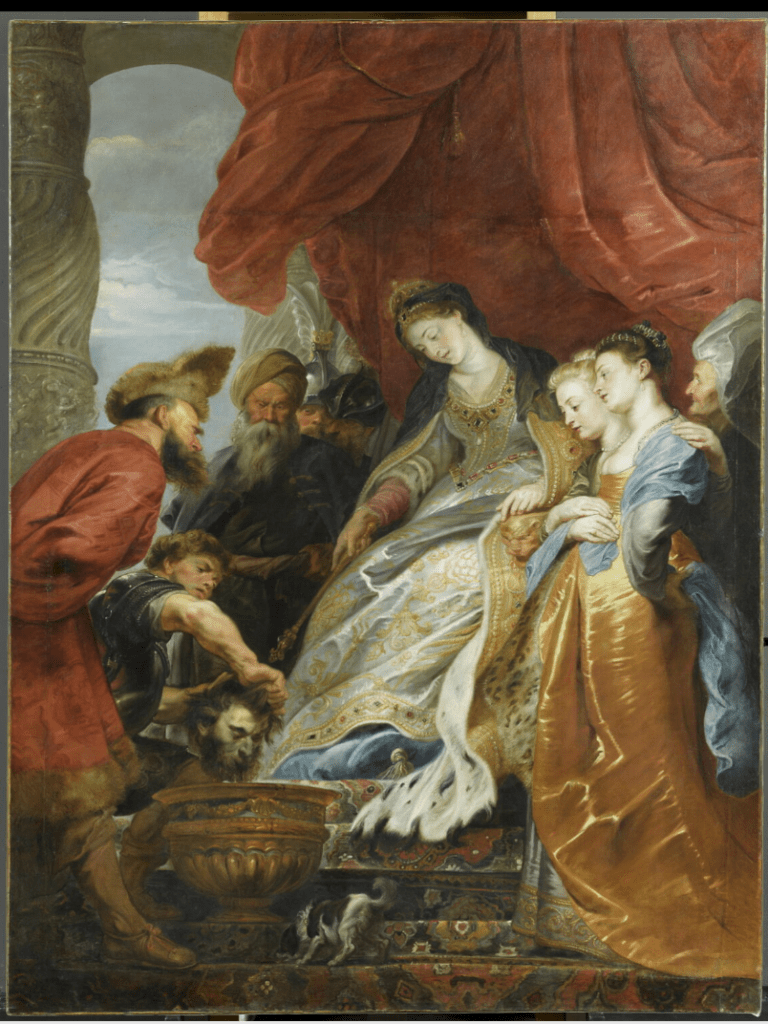
Fig. 1: Peter Paul Rubens, “Thomyris reine des Scythes fait plonger la tête du roi perse Cyrus dans un vase rempli de sang, pour venger son fils” (c. 1620-1625), Département des Peintures, Louvre Museum, Paris. Public Domain.

Fig. 2: Gerard David, “The Judgment of Cambyses,” 1487. Musea Brugge, Artinflanders.be. Photographer: Rik Klein Gotink. Public Domain.
There was, however, an important alternative set of ‘historical’ practices in which readings of the Histories were more precise, if not more comprehensive. This set includes the study of chronology, of geography, and of ‘antiquities,’ which meant something like manners, customs, and monuments recorded in ancient texts. Beginning already with the work of the great Calvinist polymath J. J. Scaliger, scholars investigating these topics used the Histories not as a storybook or a moral manual but as an archive, in which useful data such as the names and regnal dates of Egyptian or Assyrian kings might be found. Perhaps the most cited—and contentious—passage of the period was 2.142, critical, for example, to the chronological calculations of Isaac Newton.
Vernacular translations of the Histories began to be produced early in the sixteenth century, but Herodotus’ rising readership can be seen in a spate of eighteenth-century translations, beginning with Isaac Littlebury’s first full (but not literal) English translation in 1709. A vigorous debate about Herodotus’ trustworthiness—and the trustworthiness of ancient history in general—raged in France through most of the Enlightenment era, though no one believed, any more, that he had ‘lied’—the question was rather, had he succumbed to superstition, the desire to please, or premodern naivete? The debate engaged, centrally, Voltaire, who viewed the information in Herodotus’ first books as akin to the legends of Bluebeard. The Scottish philosopher and historian David Hume thought Herodotus so unreliable that he wrote, contra Cicero: “The first page of Thucydides is the commencement of real history”. Several decades later, Immanuel Kant repeated his claim.
And yet, beyond the philosophes, there was a larger world of Herodotus readers, some of them biblical apologists, others historical geographers or persons seeking Scottish or Slavic ‘Scythian’ ancestry. Geographers and proto-archaeologists such as James Rennell and Claudius Rich began to fact check Herodotus’ monuments and measurements, and were generally impressed. Herodotus’ animals had been of great interest to comparative anatomists since the Renaissance, a tradition that informed Geoffrey St. Hilaire, who spent weeks during the Napoleonic expedition to Egypt of 1798-9 checking to see if Herodotus had reported their behaviour correctly. His conclusion was: indeed, he had.
Early modern readers did, however, love Herodotus’ style, and didn’t mind his digressions, his variable forms of piety, and his salacious and comic tales. I would say that by the time of the French Revolution, then, Herodotus was more widely read and better loved than ever before, even if he had become less an interlocutor than a distant ancestor, hailing from a pre-rational world, who had certainly been sincere, but whose evidence had to be checked at every turn.
What is notable about the readers throughout the early modern period is that while they were familiar with some characters and stories from the last 5 books, e.g. Leonidas and Xerxes—almost all attention was drawn to the first 4 books. Most readers, too, seem to have been more interested in why the Persians lost the war than why the Greeks won, perhaps because the blunders of ‘despotic’ monarchs were of considerable interest to Europeans living in an age of absolutism. All of this adds up to a rich and multifaceted reception story with a very different shape than that of the nineteenth century, with its love of battles and condescension toward Egyptian priests.
Further reading:
Suzanne Marchand, “Herodotus, “Historian of the Hebrew People, Without Knowing it,” in Victorian Engagements with the Bible and Antiquity: The Shock of the Old, ed. Simon Goldhill and Ruth Jackson-Ravenscroft (Cambridge: Cambridge University Press, 2023): 47-80.
Suzanne Marchand, “Finding Truths among the Lies: Fact-Checking Herodotus’ Egypt in the Long Eighteenth Century,” in History of Humanities 6, no. 1 (Spring 2021): 269-93.
 Herodotus Helpline